orWine Tastings in the Comfort of you own villa or B&B while on holiday in Tuscany or Liguria

To book an informative and fun wine tasting whilst holidaying in Italy or arrange for a wild food walk in your area contact me on tuscanytipple at libero dot it or check out my Facebook page

Total Pageviews

Showing posts with label asparagus. Show all posts

Thursday, 19 September 2013

Planting Trees and Asparagus Bed

First of all apologies to all my blogging friends for not frequenting or commenting on their blogs, my internet connection is a little difficult what with us having no electricity where we are still camping in Rozovets, Bulgaria, being dependent on the good will of the local bar to re-charge the laptop, but the connection there being extremely slow.  Whilst when in the nearby provincial town the connection is faster, but I'm limited in time until my battery runs out again.  So here come the latest news from the Rozovets project:

At the end of September we visited the plant sale at the Balkan Ecology Project in Shipka, about hour's drive north of us and purchased some plants for Vasko's land.  This is a great permaculture project run by an English family and their Bulgarian neighbours.  I might get around showing you some pics from there too some time soon.  Anyway, what we bought and subsequently planted is this:

A pea tree caragna brevispina.  This is a nitrogen fixing tree growing up to 20 metres high producing edible pea-like pods.  Although it grows quite tall, it is slender with light foliage and doesn't throw too much shade.

A Cornelian cherry cornus mas.  A shade tolerant shrub, small tree producing delicious cherry-like fruit.


A Japanese quince chaenomeles speciosa.  Another shade-tolerant shrub producing quince-like fruit.


Autumn olive elaeagnus umbellate.  A nitrogen fixing small tree producing delicious and nutritious berries in late autumn.


A sea buckthorn hippophae ramnoides. Another nitrogen fixing shrub which makes an excellent wind break and produces berries rich in vitamins and minerals.


2 chocolate vines akebia quinata.  A climber producing edible leaves and fruit.  The leaves make a good addition to the salad bowl, while the fruit has a delicate sweet flavour.  Can also be grown as a ground cover.


A dewberry rubus caesius.  A small shrub which functions as a ground cover in shady areas, producing small edible berries.


We also bought some asparagus plants, the variety being 'Washington'.  We've seen them in Shipka and they grow to an enormous size.  It was recommended to keep them indoors over the winter before planting them, but as we have nowhere to put them we chanced it and made a nice 'lasagne bed' for them on a sunny spot.  We put cardboard mulch down, topped by cow shit and finally a thick layer collected from the pine forest above of a mixture of pine needles and horse shit.  We lined the bed with bottles of wine mostly consumed by ourselves during our stay, but as you can see, we still have some way to go...


Finally in the medicinal herb bed the liquorice is doing well (also purchased at the plant sale).


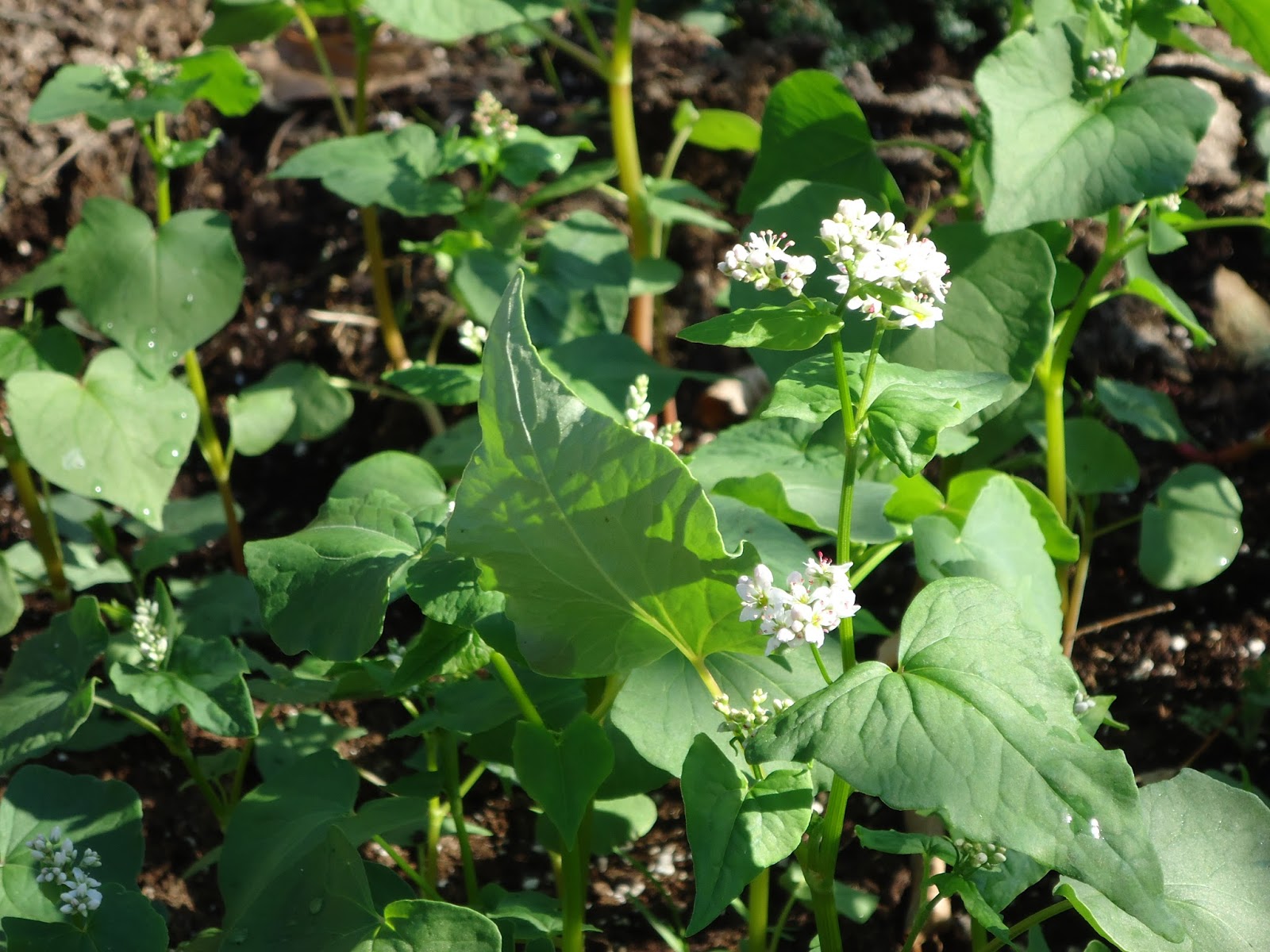
And the bits where we haven't planted anything in particular yet we have sown some green manure, such as in this case, buckwheat, which is growing rapidly and already in flower:


Wednesday, 24 March 2010

It's asparagus time!


We went off on a walk to our post office today. It was the first day of the year on which we went out of the door, walked a few metres, and then decided, there was no need for a jacket at all!

Anyway I had already decided that dinner was going to be a risotto involving some of our leek and some borage I was going to pick on the way to the post office. On the way back we decided to take the more scenic route, over the mountain, through the woods and past the old castle ruin.

And suddenly I spotted them! Wild asparagus!

In previous years I've always kind of missed the boat. Gathering asparagus is a very popular past time here, and if you don't get up early enough, they will literally all be snapped up before you realise the season has begun. So they must have just produced their long shoots a couple of days ago.

To the untrained eye, asparagus isn't that easy to spot. The trick is, you start looking for the weed weeks before the season starts and memorise where you've seen them.


The weed is much easier to spot. Once you've seen a few you start looking around for the shoots. They can be quite a distance from the rest of the plant. They grow very long and wind themselves around other plants. Of course wild asparagus is much thinner than the commercial variety, but no less tasty!.

The outstretched tongue is for those of our greedy neighbours I've beaten to the first harvest this year and to a certain so-and-so, who tried to make me jealous yesterday with boasting about her asparagus meal (she'll know who I'm talking about... :-)).

I should've maybe not mentioned this in my blog at all lest I trigger a stampede into the woods in the next couple of days, but I think most of our neighbours have already cottoned on to the fact that it's asparagus season. On our way out of the woods we met an elderly couple with baskets heading into the woods. And as we approached the village we bumped into Bruno, who asked me if we had found any asparagus, despite the fact that I had disguised them in a non-see-through plastic bag. Can't keep anything a secret here for long!

Here's a funny gnawed tree we saw on our walk, which no doubt will fall over soon.


... and on our land, after the almond and plum trees, now the peaches in flower.