orWine Tastings in the Comfort of you own villa or B&B while on holiday in Tuscany or Liguria

To book an informative and fun wine tasting whilst holidaying in Italy or arrange for a wild food walk in your area contact me on tuscanytipple at libero dot it or check out my Facebook page

Total Pageviews

Showing posts sorted by relevance for query purslane. Sort by date Show all posts

Tuesday, 18 August 2009

free super foods

Like the Italians I'm always on the look-out for free food to be gathered from from the wild. Whatever the season, there's always something: aspargus, blackberries, elderflowers and elderberries, wild onions, chestnuts, to name just a few of the more obvious ones.

Now I have found a new one. I had an e-mail from the American Simply Recipes Web-site (http://simplyrecipes.com/) with a recipe for a Tomato, Cucumber and Purslane Salad (http://simplyrecipes.com/recipes/tomato_cucumber_purslane_salad/). I had never heard of purslane before, but there was an explanation and various links, including an article in Wikipedia (http://en.wikipedia.org/wiki/Portulaca_oleracea). It's scientific name is Portulaca oleracea and is also known as Verdolaga, Pigweed, Little Hogweed or Pusley. It's particularly popular in Mexico, but is also considered a delicacy in parts of Europe, Greece and Turkey in particular.

Looking at the pictures and descriptions I thought, I know this stuff... I've been pulling it out from amongst my peppers and aubergines in great big bundles as a weed. Nobody's told me it's edible. This is what it looks like.
Well, if you find this in your garden, don't pull it out, it's deliciously fresh and crunchy, and not only that, it's one of the richest sources of Omega-3 fatty acids, in particular alpha-linolenic acid. These are essential fatty acids, which cannot be produced by the body and its other prime source is fatty fish such as mackerel or salmon. Do you know what fish costs these days? And this food is entirely free. There were also links to some other recipes such as Purslane, Tomato, Tomatillo Soup or Pickled Purslane. I shall try my way through them and experiment a bit. We tried the salad this evening and it's good!

Oh, and I know you've been dying to see the othe 3 cats, here they are. From left to right: Rooney, NoSi and la Mamma, Tigger


Monday, 12 October 2009

Of gadgets

I've never been much of a gadget person. I don't need the latest technological advances at my fingertip or the newest kitchen aid, just because it looks stylish. Why have a camera inside a telephone, when a camera does the job of a camera already? I don't even know how to operate a microwave oven and I'm completely lost when a technical discussion starts involving terms like dongle or HTML or such like.

I have nothing against new gadgets as a matter of principal, but I just hate something clattering up my kitchen, which gets used only once a year or so. So far in the kitchen my gadets tended to mostly like this:

In addition we have a simple food processor, our fantastic hand driven tomato mill to make all those gallons of tomato sauce every year and a set of reasonably sharp knifes apart from the usual set of pots and pans and bowls.

But NOW, with some of Susan's birthday money, we got ourselves a new machine and , frankly I don't know how we ever managed without it: a wholefruit juicer. It's brilliant! With our gluts of various fruits and vegetables, this is a great way of using them up without any waste. It just juices anything in seconds, apples, pears, carrots, tomatoes, you name it. Whereas you wouldn't normally eat 4 apples in a row, if you juice them, you get a generous glass of real apple juice, with all the goodness in it.

We have just got a whole box of apples and pears from Graham and Anna, the people we have recently helped with their grape harvest. The apples are a local variety called Rotelle and are absolutely delicious: sharp and juicy and packed with flavour. The pears are huge and sweet. So now we make a pear and apple juice every morning. And when we work on our land, I now always gather a few extra ingredients to make an energy reviving, delicious and healthy juice.

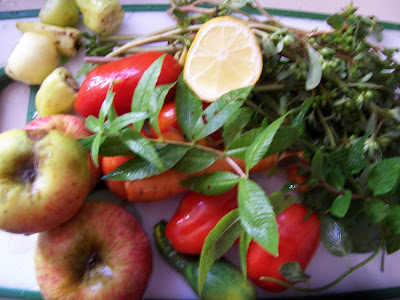
Here is one I prepared today:

Can you tell all the ingredients: apples, carrots, tomatoes, a small cucumber, a few small yellow peppers, purslane (remember that super weed that I introduced you to recently http://pathtoselfsufficiency.blogspot.com/search?q=purslane), a slice of lemon, a sprig of mint and a sprig of lemon verbena.

All that goes whole as it is (washed first of course) into the juicer:

Turn it on and press it down:

and drink with a bit of ice:

It's like a liquid salad, tastes great and did you see what all goes in it! I reckon everyone should have one and I promise I'm not on commission with the manufacturer.

Saturday, 19 June 2010

A wash-out!

This post was originally going to be entitled "Eddie's first holiday". You see one of the reasons we often fall a bit behind with work on the land is the distance between our house and our land. We have now been able to acurately measure it, it's 12.5 km, which we usually cycle. So if you have a slightly mixed day weather-wise, you tend to not go, because a) there's no shelter when it comes pelting down, and b) it's not worth the effort cycling over for just half a day to do an hour's work or so.

So because there were so many things which needed done, we came up with this plan. Our last batch of visitors stayed in a couple of tents on our land. After they left we left my tent up there, so we could use it when there was a prospect of 2 or 3 decent days. It would be like a mini-holiday. We did take the car though to bring all the stuff we would be needing for eating there and sleeping there. The forecast was for a fine dry day on Friday with occasional light showers during Saturday (today). We were going to work really hard the first day, and the second day just shelter in the tent from those "light showers". And if the weather forecast proved too pessimistic we could possibly stay a third day.

We'd have a nice dinner with a freshly picked salad and maybe something grilled and snuggle up in out very small tent.


This is what really happened. Friday as we drove towards Arcola, dark clouds started building up. This proved to be a brief shower, which was followed by another later that morning. So we still did get a fair bit of work done.

In the evening I went and gathered a salad. We had brought boiled potatoes, which we mixed with various lettuces, endive, wild rocket, purslane, basil, parsley, chicory etc. With it we had the first of our courgettes roasted with some garlic and rosemary over a fire. All that was washed with a glass or 3 of red wine.

So far so good...

As it got dark and we were sitting lazily by some candlelight, it started raining again. So we decided to call it an early night and thus having an early start. Plenty more to do! Eddie liked the tent and we just heard some occasional sprinkling of rain on the outside. No noise and very peaceful.

Then about 5.30 am... the heavens opened. One thunderstorm after another came rolling... no crashing down the valley. Several lightning strikes felt uncomfortably close. It went on for a full 5 hours, after which it just continued raining. I was on my hand and knees (very low tent, you see) to pray to whichever divinity I had offended, to please stop punishing me!

Here's the tent under the plum tree by the potato bed on terrace 15.


This is our dinner table in the aftermath of the deluge. Note the salad bowl. That was empty the night before!


The main job that did get done, much overdue, was weeding amongst the tomatoes, cutting off their side shoots and tying them up. The kiwis seem to be enjoying all this rain as well as they seem to be growing better than in previous years. Unfortunately the most vigorous one is Stud the male kiwi (incidentally, am I the only one who gives his plants names?: Stud the male kiwi, because he has 2 girlfriends, Stan the plum tree, Olli the olive tree, Adam and Eve the fig trees and the 2 smaller ones, Kain and Abel, Max the pumpkin, Hazel the Hazel shrub, Popeye the big olive tree, etc), who is not going to give us any fruit, but is only there for pollination purposes.

I managed to weed another bed with aubergines, parsley and Swiss chard. Most of the garden looks remarably good despite the lack of sunshine. This is the terrace with sweet corn and curcubita, such as the wonderful looking Arbarello di Sarzana courgette and the butternut squash.


Thursday, 29 July 2010

Wild Food of the Month July: the pine kernel

Before July is over, and as it's been raining today, here another installment of our popular series: Wild Food of the Month. Summer is a time when I do slightly less wildfood foraging, because there's such a glut of cultivated veg in the garden, which doesn't mean we cease finding free food altogether though. We eat purslane on a practically daily basis in salads and as part of mixed juices. Now I have discovered amaranth it's leaves feature regularly in soups and bakes. Not to mention early windfall apples and pears providing us with juice. But today I'd like to talk about something you may not readily associate as a wild food.

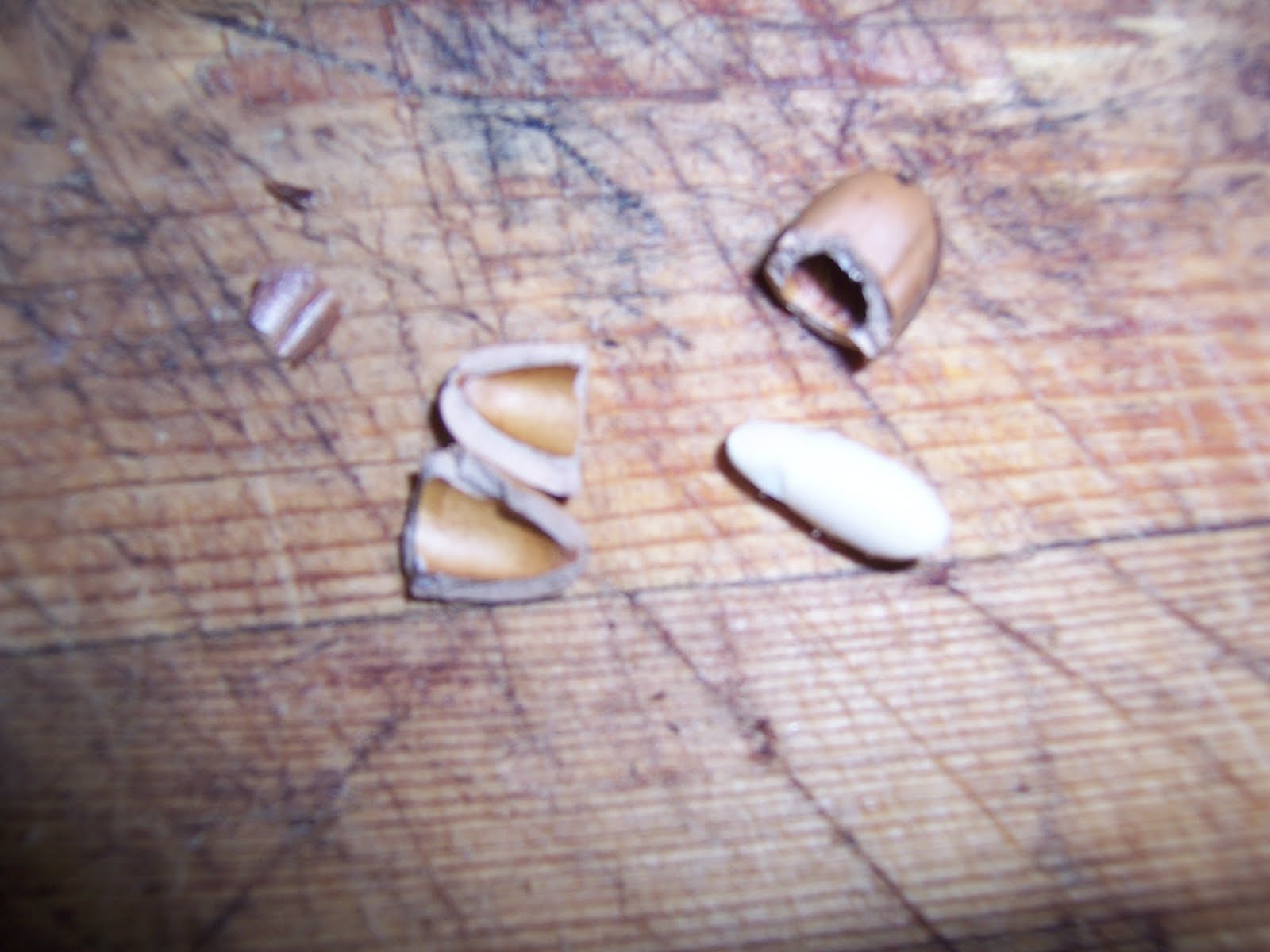
The seeds of all species of pine tree are in theory edible, however most are far too small and fiddly to bother with. The most commonly used pine kernel comes from the Mediterranean stone oak. You gather the cones around this time of year, checking them for evidence of seed. You will probably find some loose on the ground as well.


Then you peel of the scales on by one to reveal one or two seeds under each. This is an extremely messy and sticky job as you can see from the state of my hand, mind you it smells nice.


Next you have to crack the hard shell around the actual pine kernel. You can do this with a wee tap of a small hammer (sorry couldn't find a smaller one),


or with the narrow bit of your nutcracker.

If you are unlucky your shell will be empty, as happens with at least 50%


But if you are lucky you'll find a small precious pine kernel.

The shell is extremely tough so it took me the best part of an hour to just get a small handful. It explains why they are so expensive when you buy them in a shop, however, fresh like this they actually taste of pine resin and are really aromatic, unlike most shop bought varieties which only seem to add texture to your pesto.

Yes and pesto is of course the traditional way of using pine kernels in our parts, but it's lovely added to other dishes too. I used the other day to add to a squash, dried fruit and pine kernel Pilau. That was after I had finished playing silly buggers with the squash and pretending I was Johnny I'm-a-bit-constipated Wilkinson kicking a penalty in rugby


Tuesday, 31 May 2011

On Weeds and the Meaning of Life

Every plant-loving gardener massacres plants by the tens of thousands every year. A market gardener kills millions every week.  And their only crime is that they are seeking their place in the sun.  Tragic isn't it?  For them, natural selection has been superseded by the whim of a bloke with a sharp stick.
Chas Griffin from More Scenes from a Smallholding


It's the time of year again where we battle against those un-invited guests in our gardens: weeds.  Don't you hate them?  We spend so much time detroying plants instead of getting on with the real job of growing plants.  But hey, hang on a sec...is this really so?

First of all we need to define weeds.  They are spontaneously growing plants on cultivated land on which we have high hopes of growing something else.  But are all weeds bad?  Let's take a look at some of them.

On the photo above Susan is clearing the plants threatening to engulf some coriander and chives seedlings.  I like coriander... and chives.... not so much grass or these tall plants pretending to be parsley when young.  So weeds = bad.

Amongst all this here I'll be searching for shiso, parsley and leeks.  Again, not good.

But, what about this one:


 In front of my experimental plot of Greek corn several leafy plants like this have popped up.  Wild beet.  Delicious and heathy eaten just like spinach.  Also pretty non-invasive, so we'll let that one live (until it ends up in the soup, that is... or the vegetable tart...)

Or what about this one:


Amongst my tomatillo plants, there's some fleshy ground covering stuff, what's that?  Purslane.  The best source of Omega-3-Fatty Acids in any land based food.  Great in salads.  Again we leave it where it is and eat it over the summer with tomatoes and cucumber.  Mind you I can spot one of those pretend parsleys amongst that crowd too!)

And then there's this one:


Pigweed.  A relation of amaranth and considered a superweed by Monsanto farmers, because it is resistant to roundup.  I like it for that simple reason alone.  It is also edible cooked like spinach.  However it is rather invasive and there's only so much of it you can eat.  So I've been pulling some out where it threaten to take over my Buenos Aires beans and left some elsewhere, where it wasn't so much in the way.

Do you recognise this one?


Of course!  Borage.  Flowers and leaves are extremely tasty in salads or stuffed into ravioli.  Some people sow them deliberately, but mine came from nowhere and I leave it wherever it feels comfortable.  It's only an annual plant anyway and is loved by bees.

And this one here is entwined with a pretty yellow flower behind a squash plant:


Not only has that plant pretty yellow flowers it also attracts bees and other pollinators galore, a good thing for the garden.


You see, it's not always so simple to tell what is a weed and what isn't.  Many are edible or in other ways beneficial to your garden. 

This has also got me thinking of the quote above.  Plant-loving gardeners killing tens of thousands of plants every year?  Well do we?  I actually find it very hard to actually kill a weed.  And how to do you count how many species you manage to eliminate.  Going over a bed with a hoe will keep the weeds down for about.... a day?  The same species will come straight back at you.  Even if you employ the mind bogglingly boring and tedious finger and thumb method, pulling the weeds out by the root, you'll succed in keeping them down for maybe... 3 days... if you are very lucky.


And aren't those plants the same individuals?  Just a fraction of the root stays in the soil and imediately push up a new plant.  Genetically the exact same as the previous one.  Is this not the same plant that you 'killed' 3 days ago?  Are they like the Lord Jesus and come back after 3 days?  It's a miracle!!!

Some weeds have such long tap roots shoots of the same plant pop up several metres apart, like the bamboo that continiues to defy all our efforts to eliminate it.  Or grass.  How do you define an individual gras plant on a lawn or meadow?  It makes you think, doesn't?  Well it makes my tiny brain wonder anyway....

If the borders between individual plants are a bit blurred, maybe our whole idea of individual lifeforms doesn't fit.  With the whole world, all life on earth being intricately connected, maybe the whole idea of us being individuals is an illusion.  After all our bodies are made from second hand bits that once were something or someone else and are constantly being replaced.

My ethics are built on the fact that if all life is inter-connected anything I do to hurt another life-form ultimately comes back to me.  This doesn't mean that I won't hurt other life forms.  Apart from me killing tens of thousands of weeds I also kill plants to eat, not to mention animals.  It's part of life that we do so.  But it does mean that I do my best not to contribute to the wholesale destruction of the planet, because ultimately it's me, or what will be left over of me and transformed into another lifeform and another and another etc that will be hurt.

So treat all life with respect, you may come back as a Monsanto defying amaranth plant...  With this, happy summer everyone!

Oh and finally... the fruit season has begun, hooray:

Thursday, 22 August 2013

Keyhole Bed for Medicinal Plants


We have now camped on Vasko's land in Rozovets, Bulgaria for over a month and are well finished with the survey and analysis of the land and finished the design starting to implement the first permanent design elements.  Vasko's wife Elka has a keen interest in medicinal plants and so one of the elements which we have already put in place is a keyhole bed for medicinal herbs.  The keyhole bed is a classical permaculture design, which is both space saving and pleasing to the eye.  The idea is that you plan a large round bed with a space free in the centre, so that the wide bed is accessible from either side without the need to step on the bed itself.

From the soil analysis we gathered that we he have two distinctly different soils: 1) the lower, southern part, which has a reasonable depth of sandy silt over a layer of chalk and possibly some clay a bit deeper down.  The ph is pretty much neutral and it is low in nitrogen and magnesium. 2) the higher northern part with almost no topsoil to speak of, just a rock hard chalky surface.

We decided to place the keyhole bed on the northern side, at the border between zones 1 and 2 in relation to where we intend to construct the strawbale house next spring, with the entrance pointing north for easiest acces from the house and also therefore having the path at the postion where there will potentially be the most shade from the plants.  So one of the first considerations was to create some topsoil, but first we wanted to outline the area and level it.

The dimensions of the bed are an outside diameter of 4 metres and an inside diameter of 1.2 metres.  That way the bed has a width of 1.4 metres all around and can easily be accessed from both sides with a reach of 70cm.  We had already dug a swale (more about that on another post), so we wanted it to fit below that.  With a stake in the centre and a piece of string of the appropriate length we measured the outer circle.  Then with an A-frame we measured a level diameter and placed stones around the lower perimeter with the stones from the mysterious stone-walled hole we found on the property.


Next we dug the soil from the higher end to the lower end to level the bed, a difficult and bone-breaking job, given the aforementioned hardness of the ground.  We then completed the stone circle, leaving a gap of 60cm at the northern end for the path.  Next we measured the inner circle, lined it with stones and connected the two circles to give a small path into the centre.


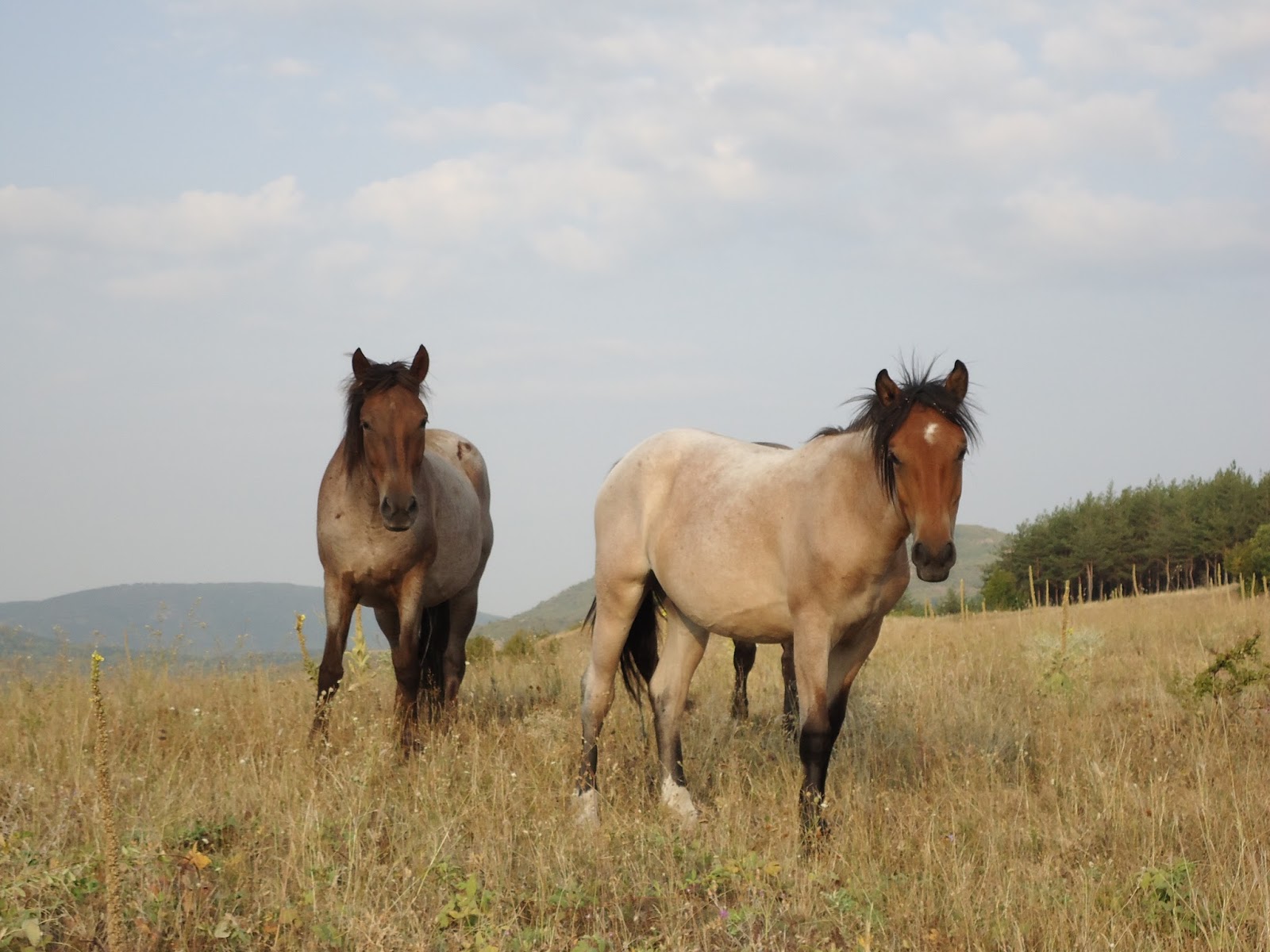
Now we were ready to make some soil, having also loosened the subsoil somewhat.  First we covered the area with some weed cuttings from the land to form a thick mulch.  The countryside above the land is mostly grazing land for cows, sheep and at least two herds of wild horses, so we went on numerous trips up the hill with a bucket and spade to collect their offerings and pile it on top of the mulch.  Meet some of our generous donours...

And this was the result of our efforts so far.  We also added an old hollow tree trunk we found, which adds a little height.

Finally we topped it all with some shop bought compost, as we haven't produced any of our own yet, and started planting and sowing some things, such as the hyssop in the foreground:

and the cowslip in the tree trunk:

For a full list of the herbs planned, see below.  We have also started enjoying the fruits of our labours, such as these delicious sweet and seedless grapes, more than we could eat, so we are attempting to dry them in the garage, protected by mosquito netting so the wasps don't get to them


And these small purple figs:


Now for the list of medicinal plants for those of you that interested.  I separated them into shade-tolerant and sun-loving plants and listed them more or less in descending order of height, the idea being to put the tallest shade tolerant plants on the northern side and the lower sun-loving plants on the south, if that makes sense.  I'm also giving the Latin names, their chief medical properties and other uses, as in permaculture every element should fulfill multiple functions.

Shade-tolerant plants:
  • Lovage levisticum officinale - skin and digestion aid - edible, makes a good addition to soups with a celery like flavour
  • Purple Loosestrife lythrum salicaria - wound herb, soothes sore throats - bee plant
  • Burdock artcium lappa - skin problems, anti-bacterial, rheumatism - edible root, dynamic accumulator
  • Comfrey symphtum officiale - bruises, sprains, broken bones, chest complaints - edible leaves, dynamic accumulator, bee plant
  • Sweet Cicely myrrhis odorata - diuretic, aids digestion, antiseptic - edible leaves
  • Clary Sage salvia sclarea - eyes, tonic, menopause - bee plant
  • St. John's Wort hypericum perforatum - skin, burns, anti-depressant - leaves and seeds as tea substitute
  • Peppermint mentha x piperita - digestion, headaches, colds - edible leaves, tea, ground cover
  • Yarrow achillea millefolium - blood stemming, menstrual problems, influenza - edible leaves, dynamic accumulator
  • Borage borago officinalis - blood circulation, rheumatism, anti-depressant - edible leaves and flowers, bee plant
  • Chamomile anthemis nobilis - calming, digestion, colds - ground cover, tea, dispels pests
  • Bergamot monarda didyma - antiseptic - edible leaves, tea, bee plant
  • Lady's Mantle alchemilla xantochlora - menstrual problems - ground cover
  • Red Clover trifolium pratense - PMT, menopause - ground cover, nitrogen fixing, edible leaves and flowers
Sun-loving plants:
  • Liquorice glycyrrhiza glabra - stomach ulcers, hepatitis, insect repellent - edible roots, dynamic accumulator
  • Centaury centaurium erythrea - stomach, liver, gallbladder - bee plant
  • Mullein verbascum densiflorum - ear infections, coughs, pulmonary problems - bee plant, dynamic accumulator
  • Tansy tanacetum vulgare - digestion, expels worms, rheumatism - edible leaves
  • Hyssop hyssoppus officinale - antiseptic, tonic - edible leaves, bee plant
  • Fennel foeniculum vulgare - digestion, anti-bacterial - edible leaves and seeds
  • Fenugreek trigonella foenum- graecum - digestion, lowering cholesterol - edible seeds, dynamic accumulator
  • Lavender lavendula angustifolia - calming, headaches - bee plant, used in perfumery
  • Sage salvia officinalis -colds, coughs, tooth whitener - edible leaves, bee plant
  • Feverfew tanacetum parthenium - migraines, fevers - attracts pollinators
  • Lemon balm melissa officinalis - depression, cold sores, insect repellent - edible leaves, tea, bee plant
  • Nasturtium tropaoelum majus - respiratory complaints - edible leaves and flowers, ground cover
  •  Marigold calendula officinalis - skin complaints - edible leaves and flowers, dispels certain harmful nematodes
  • Cowslip primula veris - anti-axiety, cramps, blood thinner - edible leaves and flowers, bee plant
  • Thyme thymus officinalis - anti-septic, coughs - edible leaves, bee plant, ground cover
  • Purslane portulaca oleracea - high in omega 3 acids, skin complaints - edible leaves, ground cover