orWine Tastings in the Comfort of you own villa or B&B while on holiday in Tuscany or Liguria

To book an informative and fun wine tasting whilst holidaying in Italy or arrange for a wild food walk in your area contact me on tuscanytipple at libero dot it or check out my Facebook page

Total Pageviews

Wednesday, 6 June 2012

PERMACULTURE COURSE, a review. and some practical applications


I am still overwhelmed by the emotions and memories of the Permaculture Design Course which I have recently attended in Scagnello, Piemonte about 200km West of where we live.  There is only one thing I can say if ever any of you had ever considered taking the course: DO IT!

I have learned so much.  There was of course the course itself and many things weren't that new to me, you can find much of it on-line or in books.  It did help organise things in my head though and I realised that many things I was doing were already permaculture concepts without actually realising I was doing it. There is still much more to learn and the course really is just a beginning.  Often time restrictions didn't allow to get as deep into some subjects as I would have whished.

But the most amazing part of the course was meeting and becoming friends with so may inspiring and like-minded people and that will stay with me for the rest of my life:


Above just the group who chose to camp on the Permaculture Test Site, but each and everyone of the 25 particpants was a uniquely talented, positive and critical thinking person with a real vision for the future, a harmonious future.  We have connected as group like I have rarely experienced in any walk of life and we will remain a true network and some of the friendships forged I know will last a lifetime.  For a few more impressions have a look at the photos on the Italian Permaculture site and have a read (both in Italian and English) of this beautifully written e-mail a few days after the course by Andrea (also known as Mayemi).

Anyway, as I'm slowly descending back to planet Earth I have some catching up to do having been away for 2 weeks, so time to apply some of newly learned skills into practice.  Yesterday we passed another bunch of old doors on a skip on the way to our land, something I had been on the look out for for some time.  Took them straight to the land to build another raised bed on the second terrace along the same lines as the one we had already built on the first terrace and I applied several permaculture principles in its design.

The first principle we applied is that of zoning, where your house is zone 0, the area immediately outside your home is zone 1, containing the kitchen garden and the highest maintenance part of the garden, going all the way out to zone 5, which is the way and beyond, where you contemplate nature and forage.  Previously we didn't really have a zone 0 on our land, as we didn't have any shelter there, but zone 1 was centred around the 5th terrace, where initially we had the only water access, there was the tool shed, a heavy marble table and a barbecue.  We placed a small herb garden there too.

Now the tool shed has finally collapsed to have been replaced by the caravan which sits at the very top of the property.  Also thanks to the plumbing skills of our friend Stephen, we now have a second and third water connection, near the caravan.  So when our last helpers, Becky and Nick suggested moving the rest of the stuff from terrace 5 to terrace 2, where they built us a pizza oven, it made perfect sense to make this our new zone 1.  The raised beds are going to have the most labour intensive crops growing in them, so it makes sense having them on terrace 1 and 2, which is now the area we spend most time in.

This is what we did for building the raised bed:  We put the doors upright against the back of the terrace like this leaving a little bit of a gap:


In the background you can see the BBQ, table and solar dehydrator and above you can just make out the caravan.  Next I cut into the side of the terrace to level things and take some of the topsoil off the side.  There is a surprising amount of topsoil on those vertical bits, which is fed from some oak trees above.


Incidentally, talking about vertical bits, that's another thing permaculture teaches us: there are no problems, just challenges.  I've always looked at the steep gradient of our land as a problem, but looking at it from another viewpoint: On paper my land consists of about 2,000 sqm.  That presumably is calculated on the horizontal parts.  However having an average gradient of 40% that means I have an additional 700sqm of vertical land.  You might not think this to be very useful, but there are some trees growing on the vertical areas, as well as many edible herbs and not to forget, heaps of biomass, which when cut feeds the soil below on the horizontal bits!

Anyway, back to the raised bed: next I threw some of the aforemntioned biomass, which we had cut earlier a bit fiurther up the slope and filled it in to provide nutrient and build up some soil.


..and finally, also in the interest of building soil and fertility we added some donkey manure on top:


...kindly donated to us by Pietro, the donkey (not to be confused with any permaculture teachers I may have met in the recent past...)

Another principle of permaculture is to have multiple functions for each element and this raised bed certainly complies with that.
  • It is soil building as I am adding plenty of organic matter and we had lost so much topsoil during the Christmas 2010 landslides.  
  • It prevents soil compaction.  Previously I had just used the whole width of the terrace, which meant I had to walk straight through the beds and turning our heavy clay soil into hard pan resulting in poor yields.  So although I have decreased the actual growing area I am expecting a higher yield.  
  • The new raised bed will slow and store water.  Water running off the vertical side of the terrace will first hit the fertile soil of the raised bed.  The rich soil will be much better at absorbing the excess water, unlike the hard clay surface which was the previous feature of this terrace.
  • This in turn will also prevent erosion and reduce the chance of landslides.
  • Being a raised bed means I don't have to bend over quite so much when working the bed, making work lighter.  I'm not getting any younger you know!
You're starting to get the picture.  I shall be boring you guys to death with all that permaculture stuff in my head.

Wednesday, 30 May 2012

of Hugelkultur and Compost Toilet

Just a quick sign of life.  Just arrived back from the Permaculture Design Course at the Permaculture Centre of Italy.  More on this over the next couple of weeks.  But to give you a taste of the atmosphere there and the people, here a couple of video impressions:

First the first public performance of the Hoogle Culture Boogie by myself and local band Litio:


and next the more catchy tune of the Compost Toilet Song:


We couldn't quite decide which was going to be number one of the Permaculture charts...  You tell me.

Wednesday, 16 May 2012

Pizza!

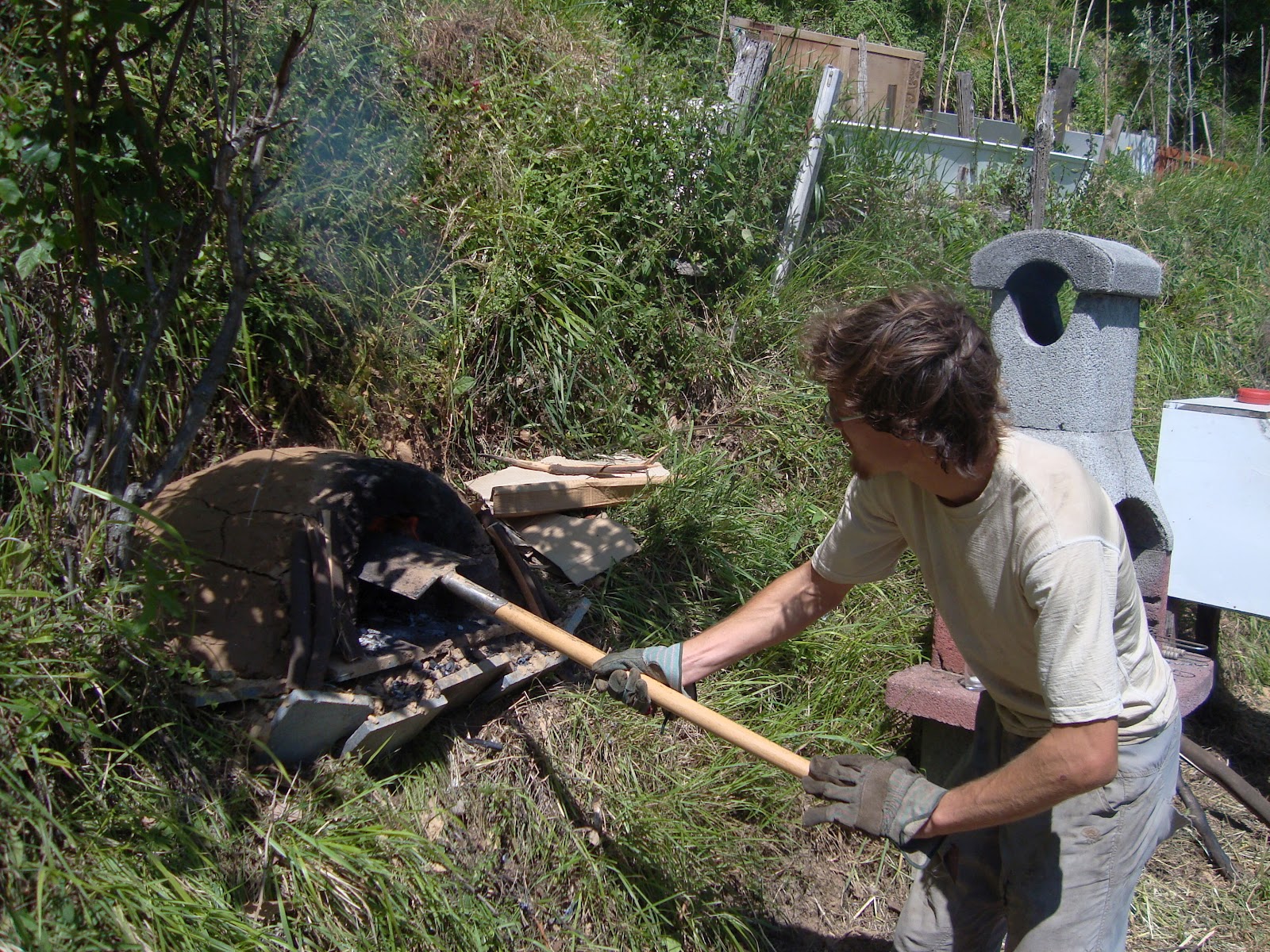
We said good bye to our helpXers, Becky and Nick today and we celebrated their final day with... PIZZA!!!  Made in the clay pizza oven the two of them had built for us.  As we were working together Nick remarked on the clay soil we've got.  He said he could maybe make us a pizza oven.  Of course I said, I like helpers with their own initiative.  Taking our cue from permaculture and having things you want to use a lot near the centre of action, we shifted everything, hugely heavy marble table and BBQ, from terrace 5 where formerly our tool shed was, to terrace 2 directly beneath the caravan, where they also proceeded to build the oven on a little ledge.

First they started playing in the mud a bit:


Then they put their heads together to plan their next step:


They made a base of some paving stones and clay:


The cardboard box became the first inner support.  More cardboard and paper was stuffed in and a first layer of clay plastered on top:


A couple of days later another layer of clay was added and the next time we were there it was already being fired up:


Here's Nick stoking the fire:


Whilst Becky was preparing the pizzas:


Here's a pizza in the oven.  So far so good...


...and finally one on the plate:


Hurray to Nick and Becky and thank you so much.  You are welcome back any time!

Oh and I'll be off the radar for the next couple of weeks as I'll be on a permaculture design course in the Piemonte in northern Italy.

Sunday, 13 May 2012

The Off the Wall Wildfood of the Month

Sometimes you just feel plain stupid.  You walk past a plant hundreds, nay thousands of times, before you realise not only that it's edible, it's tasty too and extremely good for you.

There was me yesterday putting the finishing touches to my book, checking through various reference books to see if I missed anything glaringly.  So I picked up a slim volume written by a local guy on the edible greens of the Lunigiana and the Val di Mara, i.e. our local area, and I came across a plant known as Parietaria in Italian (parietaria officinalis).  It looked kind of familiar so I googled it and found out that in English it's called Pellitory of the Wall, which I had never heard of either.  The German name of 'Aufrechtes Glasskraut' didn't enlighten me either.

Then I started reading up on it, and woah!  Not only is that stuff edible, but it has huge health benefits too.  But first I had to go and find one, so I said to Eddie the Beagle, I said: "Eddie, we're on a mission!".  So I put my shoes on, donned my camouflage gear, explorer helmet, butterfly net and hunting rifle, put my trusted hunting beagle on his lead and stepped through my front door into the great wilderness.  It took me a total of about 10 seconds before I spotted the first one simply growing out of our own wall!


and some more:

I looked at the reference book and at the plant... I think they may have taken the photo on my very front door you know, it was a definite match.  As the name suggests it grows along and out of walls.  It's common throughout most of Europe with the exception of Iberia and Britain apparently.  The leaves are maybe 5cm long coming off creeping red stalks and if you look closely at the inconspicuous flowers you'll see the family resemblance: it's part of the true nettle family.

"Now what do we do with Pellitory of the Wall?" I hear you ask.  Well actually pretty much the same as you would with stingy nettles.  The taste is similar too.  Just use the leaves and young shoots and boil them for a side veg, add them too soups or risottos or any other way you'd use green veg for.  A Torta di Verdura, vegetable tart would be nice too I reckon.  It has a mild flavour, but it doesn't fall apart too quickly when cooked.

And as for health benefits?  To quote from my own book:  "This plant has long been valued as an excellent diuretic, increasing urine production to clear the system.  Combined with stingy nettle the effect is increased.  Drink an infusion of 2 tablespoons of dried herb per litre of water 3 times a day or make an infusion and take 40 drops three times a day.  This  is helpful to combat metabolic illnesses, including obesity, diabetis and cellulites, rheumatic illnesses, such as gout and arthritis, illnesses of the urinary tract, including gallstones and kidney stones as well as renal inflammations and cystitis and illnesses of the circulatory system, such as high blood pressure and water retention.  Externally is used as a wound dressing as disinfectant."

We shall gather a whole load and dry some.  Cousin Bart has some arthritis and maybe it'll help him some.  The only word of caution, Pellitory is one of the main contributors to hayfever when in flower.  If you are a sufferer it maybe wise to avoid direct contact, i.e. let someone else do the picking.  Even I got a slightly sniffly nose yesterday when cooking with them and I don't normally suffer allergies at all.

Wednesday, 9 May 2012

Eureka! and Hooray to Helpers

Remember I asked you lot a few days ago what this plant is?

Well I've finally cracked it!  It's Fool's Watercress or as our American cousin like to call it, European Marshwort (apium nodiflorum).  It was no coincidence that we found it in a damp ditch, that's where it likes to be.  In Italian it has various common names, mostly more descriptive than the English names: Crescione (big cress), sedanino d'aqua (little water celery) or erba canella (cinnamon herb).  the latter two names really describe the flavour of this plant.  They do say it makes an excellent addition to a salad, however they should only be picked from near clean waterways and should be thoroughly washed as they might harbour parasites harmful to humans.  Another unexpected addition to the book, it's getting longer and longer!

Meanwhile back at the farm... we've had two cycling Americans all the way from Arizona helping us out.  They've been really hard working and, like us, have a keen interest in permaculture.  They've been bravely beating back the encroaching jungle, helped us plant out stuff, made us a lasagne bed, shifted leaf litter and topsoil from the woods below our 18 terraces and dragged it all to the top and they've dug a new compost toilet.  It's all been mighty impressive!

Here a few pictures of Becky and Nick in action.  First Nick dug a really deep hole for the compost toilet:

Then all that earth went in bucket 2 or 3 terraces down:

...to cover a previously prepared lasagne bed, i.e. layers of different types of organic material on top of some cardboard to keep the weeds down and add organic material to the soil:


...and did you notice?  They were still smiling!

Anyway on a final note our cat seedlings have done particularly well this year:


Sunday, 6 May 2012

of Mystery Wild Food and Odd Weeds

Working on my book I've come across two wild foods which I have never actually collected and I'm therefore unsure of how to identify them: alexanders (smyrnium olustratum) and the Ground Elder (aegopodium podagraria)  On pictures of reference books they look very similar.  On passing in the car on a wee country lane nearby I thought I had spotted one or the other the other day, so I decided to go on an expedition to find said greens.  This is what it looked like:

 It was growing in large clumps in a damp ditch next to some cultivated land near the river.  It grows to about 3 feet tall, but no sign of flowers yet.  I picked a leaf and it smelled good.  I popped it in my mouth and it tasted even better.  I cut the stem and nibbled it and woah!  It has a delicate sweet celery taste with a hint of vanilla on a long aftertaste.  Not a hint of bitterness.  I'm convinced this is edible.  It tastes far too good not to be! 

But... it doesn't fit the description of either ground elder nor alexanders.  It says about alexanders that they are solid stemmed and this...

 ...evidently isn't.  If it was ground elder it should have flowers at this time of year, but no sign of them.  Also the taste of them is said to be debatable, whilst this stuff is simply delicious.  You couldn't dislike it.  Now I'm sitting here at my desk with a wilted sample of this plant and a dozen reference books around me and I can't work out what it is.  Anybody got any idea?

Anyway, we've been using some brief breaks in the rain to start sorting through the jungle that is our land.  Help has arrived in the shape of a couple of helpXers from Arizona who are also into permaculture.  Broad beans are in full production, hmmm my favourite, and the first wild strawberries are ripe:


Below are the sub-terraces we built on the slope below the caravan from the left-overs of an old wardrobe. 

The idea was to plant out the majority of my tomatoes along there this year, plus some onions and herbs.  Somehow, having used our own compost as well as a whole collection of organic materials, all sorts of other unplanned things have started gowing there.  An elder branch and a hazel branch which were rammed into the ground to support the terraces have started sprouting.  And the amongst the tomatoes all sorts of other stuff started sprouting:  Yarrow


Jerusalem artichokes

and hundreds of little tomato seedlings as well as... possibly Swiss chard:


I don't think I ever need to sow out Swiss chard ever again.  It goes complety crazy on my land and pops up EVERYWHERE!  Just as well we like it and have a constant supply of it 12 months of the year.