orWine Tastings in the Comfort of you own villa or B&B while on holiday in Tuscany or Liguria

To book an informative and fun wine tasting whilst holidaying in Italy or arrange for a wild food walk in your area contact me on tuscanytipple at libero dot it or check out my Facebook page

Total Pageviews

Friday, 20 August 2010

Go on, guess...

No. You'll never get it. Have a go though. What ingredients do you think I have just made jam out of? ... No ... no not that either ... no you are not even close!

Here's the story while I keep you guessing. You know us gardeners always like to experiment with something new. New vegetables or exotic fruit, or a different variety like yellow tomatoes, or purple beans, or red carrots etc. Sometimes these experiments are a great success and they enrich our dinner table, other times they are not. The latter may be due to problems germinating perhaps, or just not ripening properly, or producing lots of foliage, but no fruit, the list goes on.

Failure may also be due to the fact that the resulting produce simply isn't very nice. Maybe it's a really stringy bean or you've always had a prejudice against pumpkins and approaching them again after years you find out why you didn't like them in the first place (it's the consistency... however I've made a large batch of curried pumpkin soup for the freezer, which I find tolerable).

Well my experiment gone wrong this year (apart from the pumpkin...) is a variety of greeny pink aubergine. I saw the seeds and thought: "hmm, I like aubergines, grilled, as Melanzane alla Parmigiana, under oil, in a ratatouille etc, why do they always have to be purple." They turned out to be earlier ripening than their purple cousins. One plant died misteriously, but a good 7 or 8 of them were doing well.

So it came to the first harvest, I sliced them and noticed an abundance of hard seeds inside. That would be quite good if I wanted to grow this variety again next year, but the taste test showed them to be tough and stringy and pithy with the seeds even when grilled for some time. Not very nice at all!!!

So here I was, with a bunch of happily producing aubergine plants with inedible aubergines. What to do with them? I was tempted to throw the whole lot straight onto the compost heap. Then I passed a stall at the Medieval festa of our town recently (for photos see Facebook...), and they had various homemade preserves on tasting there. And amongst other exotica there was an aubergine and chocolate jam! And you know what? It tasted good.

I didn't want to be rude and ask for the recipe, so today I made up my own. Try it, you'll be pleasantly surprised!

Ingredients:
  • 1kg aubergines, cubed
  • 2 large apples cored and roughly chopped
  • 50g cacao powder (maybe less...)
  • 600g sugar
Method:
  • Simmer the aubergines and apples in about a cup of water until well soft.
  • Press the mixture through a tomato mill or a mesh thus getting rid of the seeds and skins.
  • Return to the pan and bring back to the boil.
  • Add cacao powder and sugar and stir in rapidly on a high temperature. Boil for just a few minutes, stirring constantly until the the bubbles plop on the surface.
  • Bottle in hot sterilised jars.
Now you didn't see that one coming, did you?

Wednesday, 18 August 2010

Call me the Michelin Man

No, I haven't suddenly put on 20 stone and become bald. Let me explain... a bit later...

Well first of all apologies for the recent bloggy silence. It has various reasons: one, I have to admit, is I discovered Facebook, and despite myself, I'm rather enjoying it. Now don't get me wrong, it's not that I'm spending all day and night on Facebook now, but having found many of my friends past and present there, I decided to put the more... how shall I put it... chatty bits, you know the "our-life-in Italy" anecdotes there and concentrate this blog on what it was created for: The Path to Self Sufficiency. I know some of you enjoyed those other bits too, so I suggest you simply find me on Facebook and you'll see photos of our 20th wedding anniversary bash, a jam session we had in our kitchen last weekend, some walks we go on, Eddie growing etc and I post links to links to articles regarding the environment, music, Italy and other subjects that interest me. Some photos are for general viewing, some you'll have to be known to me. I'm easy to find, I believe I'm the only one with this name on FB. See you there if you like?

Another reason for my recent inactivity on this blog is that of course it's a busy time in the garden. Most days we are out there watering (although the last week-10days has been somewhat cooler with intermittent rain), harvesting the bounty of fresh produce and preserving it.

Finally I spent some time thinking about the direction our "path to self-sufficiency" is going to take us next. In the 5 years since we started cultivating our plot of land we have achieved I'd say 80% food self-sufficiency. We cannot produce quite sufficient carbo-hydrates (only potatoes to feed us for maybe half the year and some corn) and we have no livestock to supply us with animal proteins. We get around that by buying flour directly from the mil to make bread, buying large quantities of cheap pasta, rice and other staples whenever we do have money, bartering eggs for jam or favours and greatly reducing our meat consumption to once a week (less when we are really broke).

We are still dependant on fossil fuels for electricity supplied by the state supplier at around €50 for every 2 months (at least Italy is currently non-nuclear), to cook with gas (about 2 x10kg gass bottles per year at €16 each) some of our heating (another 5 gass bottles per winter) and to run the car, which we are trying to keep at around €20 a month, which gives us a range of approximately 200km. The largest bill by far is for communications: Currently we pay around €100 every 2 months to have an internet and telephone connection. I do have a pay-as-you-go mobile, costing me a negligible €10 a year. There's also insurance and tax for the car, which is currently being paid for us, which isn't exactly a satisfactory solution. Water bills and other taxes I've been so far successful in dodging all together in true Italian fashion.

So if you do your sums it tells you that we live on something in the region of €3,000 a year. How can we reduce that? I have recently started following the activities of Mark Boyle. He has lived for the last 19 months in a caravan without money. He is promoting his "Freeconomy" as a counter-balance to the money-based economomy. It is a kind of bartering system, where everyone within a community offers their services free of monetary charge. I very much like this concept and in many ways it still exists in the village I live in although complete independence from money is in my opinion not quite possible unless we retreat back to the caves. However, Mark's ideas are if nothing else inspiring.

So back to our situation: Let's start with the obvious, the car. Why do I still need a car? Partially to earn money, a large part is needed to run the former. The other reason we need a car is the distance between our land and our house (12.5km). Whilst we cycle and walk as much as possible, sometimes we have to transport bulky items one way or the other and there's a steep hill to climb either side of the valley.

At the moment Eddie our puppy is starting to be too big to ride on the back of the bike, but yet too small to run along. He's also in the chewing-everything-in-sight stage, meaning he can't be left home alone safely for a long period of time. So it's walking or driving at least for the moment. We can afford to drive maybe once a week. Other days I put on my rucksack and put a heavy compost bucket in it, returning with it empty but several kilos of potatoes, pears, apples, tomatoes, courgettes, aubergines, cucumbers... you get the picture. The other day I climbed back up our 300 metre hill with some 30kg on my back in the August heat.

This leaves us with very little energy to do a lot of the work that needs to be done and would therefore make us more independent, and we fall behind with pockets of jungle taken over various corners of our land. Also it greatly increases our calorie consumption, meaning we have to grow more to feed our greater calorie need. It's one of the reasons we are not complete vegetarians, because we literally crave higher value calories at times, feeling list-less and exhausted at times.

This summer we had come up with a part solution in setting up a semi-permanent tent on one of the lower terraces, but man I'm getting old. When I was young I didn't mind lying on any surface to sleep, but now I get up after a night on hard ground and I have trouble moving and my back is killing me, which is not conducive to a second days hard labour on our terraces.

Last year we had planned to build a larger and more solid wooden shed than our existing one, which looks like this:


We had gathered a lot of scrap wood off tips and were ready to start when I drove that %~+>£&** piece of bamboo into my arm. That put me out of any serious work for 4 months by which time the olives became a priority and then the weather changed. Now I look at the pile of timber gathered rotting on the top terrace and think of my efforts in woodwork classes in school. I was the kind of kid that came home with my piece from woodwork class and my parents would enthusiastically pronounce: "What a lovely... hedgehog?... piggy bank...? thing!"

Now finally the connection with the Michelin Man: last week I came across this web-site about how to build a house (low skill required!) entirely from recycled material, namely old car tyres, plastic and glass bottles and aluminium cans. They called it an earth-ship And hey presto a plan evolved in me head, but PSSSSSSSSST!!!! don't tell anyone. Strictly speaking I have no planning permission to build a dwelling on our land and not likely to get one either. I am allowed an up to 12m2 agricultural building, but I want more. The plan is this:

I'm intendingto construct a semi-permanent structure on our land using old car tyres filled with our clayey sub-soil (I knew the clay would be useful for something!) as main supporting walls. Some parts will however be sunk into existing terraces and covered up again with a vegetation covered roof, making them invisible from the outside, quasi underground. Not sure yet whether the vegetation will be grass growing on top or simply some climbing plant. Having in the meantime spoken to a couple of people with an engineering background, I was advised that the weight of the tyres might cause my terraces to subside, and I can see that.

Having chosen a realitively shady area with not much growing on it bar weeds on terrace 6 for the location of what I estimate to become an approximately 25 m2 house, I decided to build a foundation on terrace 7, also from tyres.

Not one to hang about for long, project Earth Ship got under way yesterday:


The only problem now is to find a sufficient number of tyres, so if you read this and you are in the area, please let me know of any hordes of dumped tyres, pick up any you may find on the side of the road, safe any from the tyre change on your car, please.

Eddie was helping too.


The idea is that I would like to build a building where I can store my tools and equipment safely, and which has a proper sleeping area, a kitchen and a bathroom. This way we can spend most of the summer there, use our produce fresher (rather than mashing them on the back of a bumpy bike only then to carry part of them back as compost), we'll have facilities to preserve them on-site and we have a shelter near our food source.

Longer term we may be able to work out some energie and communication solutions which won't involve being connected to the main network. We could possible sell our current house to finance things like solar panels and water retention systems etc. We wouldn't need a car any more and we may be able to keep some livestock.

This obviously is going to take us a while. I need to do a lot of excavation and more importantly we need to find a couple of hundred tyres and transport them to our land. Any advice by anyone on this would be much appreciated. Anybody wanting to get their hands dirty and help, you are more than welcome. For the moment Eddie is having a rest from his part in digging on the beginnings of the foundations:

Thursday, 29 July 2010

Wild Food of the Month July: the pine kernel

Before July is over, and as it's been raining today, here another installment of our popular series: Wild Food of the Month. Summer is a time when I do slightly less wildfood foraging, because there's such a glut of cultivated veg in the garden, which doesn't mean we cease finding free food altogether though. We eat purslane on a practically daily basis in salads and as part of mixed juices. Now I have discovered amaranth it's leaves feature regularly in soups and bakes. Not to mention early windfall apples and pears providing us with juice. But today I'd like to talk about something you may not readily associate as a wild food.

The seeds of all species of pine tree are in theory edible, however most are far too small and fiddly to bother with. The most commonly used pine kernel comes from the Mediterranean stone oak. You gather the cones around this time of year, checking them for evidence of seed. You will probably find some loose on the ground as well.


Then you peel of the scales on by one to reveal one or two seeds under each. This is an extremely messy and sticky job as you can see from the state of my hand, mind you it smells nice.


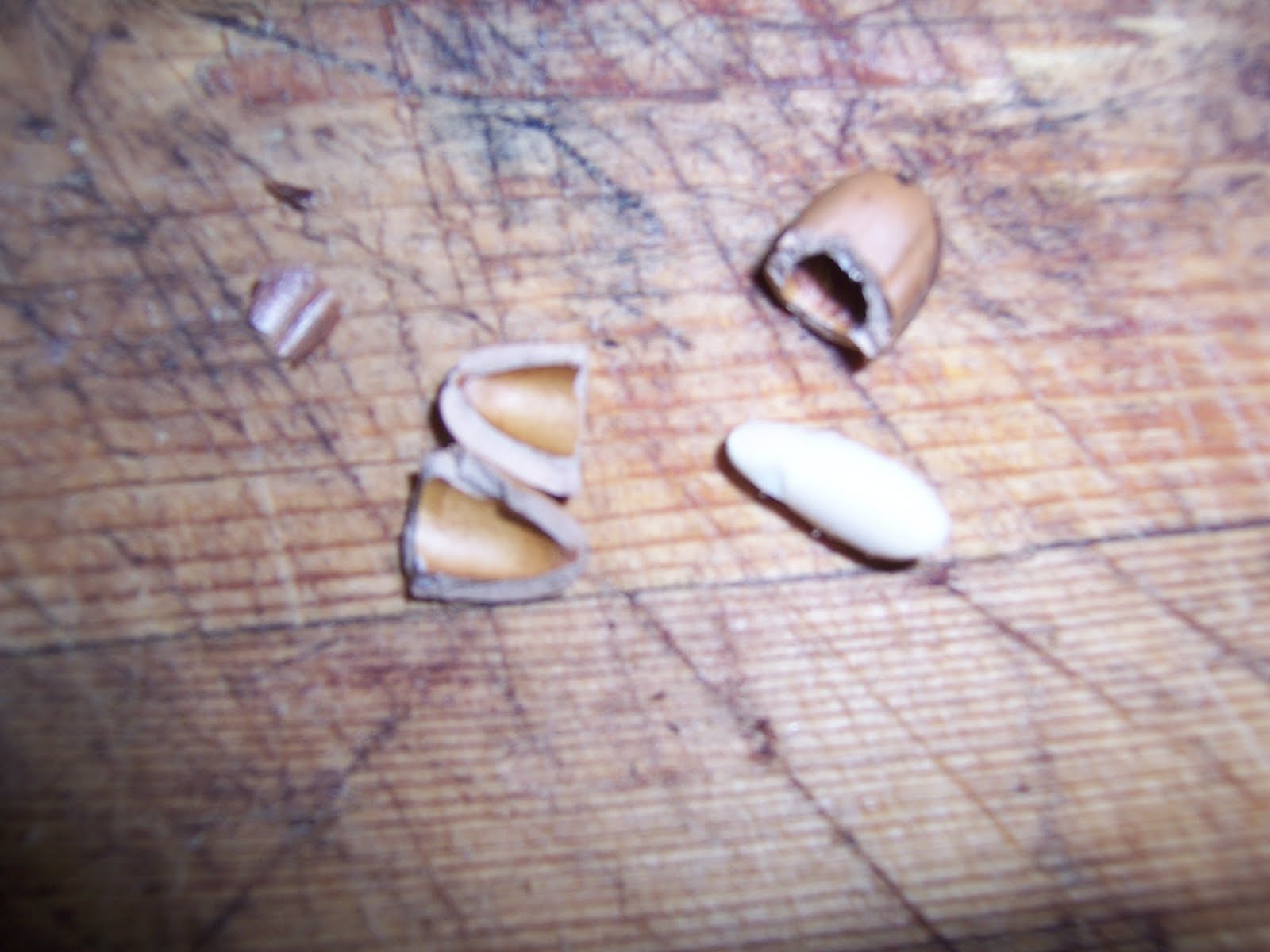
Next you have to crack the hard shell around the actual pine kernel. You can do this with a wee tap of a small hammer (sorry couldn't find a smaller one),


or with the narrow bit of your nutcracker.

If you are unlucky your shell will be empty, as happens with at least 50%


But if you are lucky you'll find a small precious pine kernel.

The shell is extremely tough so it took me the best part of an hour to just get a small handful. It explains why they are so expensive when you buy them in a shop, however, fresh like this they actually taste of pine resin and are really aromatic, unlike most shop bought varieties which only seem to add texture to your pesto.

Yes and pesto is of course the traditional way of using pine kernels in our parts, but it's lovely added to other dishes too. I used the other day to add to a squash, dried fruit and pine kernel Pilau. That was after I had finished playing silly buggers with the squash and pretending I was Johnny I'm-a-bit-constipated Wilkinson kicking a penalty in rugby


Monday, 26 July 2010

Tomatoes and other veg

Today I would like to bore you with lots of pictures of tomatoes. Due to the freak weather conditions I got my tomatoes off to a late start. The first lot frizzled to bits in my cold frame during hot March days. The next lot experienced extremes of cold and damp. The ones on the following photos are from the seeds Mr H. from Idaho kindly suppied me with. I only sowed them out late April, so I'm quite pleased that most of them are ripening already not much later than I would normally expect.

I must also admit I'm the world's worst organised gardener. I frequently forget what I sow where and even if I make a note I then forget where I transplant it to. It's obviously easy to distinguish a tomato from say a cucumber, but when it comes to tell different tomato types, I get confused. So, knowing this, I endeavoured to plant at least the first lot in alphabetical order to the 10 different varieties Mr.H sent me. The rest is all a bit higgledy-piggledy, but I have my first 10 as reference plants. So here we go

#10 Red

Black Cherry (delicious!)

Bursztyn

Gruntovi Gribovski

Orange Smudge

Red Cherokee

San Marzano Roma (obviously not ready yet)

Targinnie Red

Taxi

Turkey Unnamed

This was today's colourful tomato harvest. Looking forward to growing my very own "Heiko" tomato next year

For those of you not so much into tomato photos, here for something different:

Red amaranth flower. Yes another one growing spontaneously. And I'm pleased my red-stripe amaranth has taken too.


Green aubergine. It's well ahead of their purple colleagues.

Chicory


Pears almost ready. It's an early variety and it's actually slightly late this year, but the more bountiful.

Florida Cranberry. After a slow start during the cold spring, the ones in more exposed positions are starting to look like proper plants now.

Wednesday, 14 July 2010

Images from a summer garden

Dwarf bean "Purple Queen"


Cucumbers galore


First tomatoes: a volunteer large grape tomato.


An apple tree I had almost given up on after some snow and storm damage 5 years ago, producing some early fruit again for the first time.


Butternut squash


The wild flower bed.


... and amaranth. That's it, isn't it?

Saturday, 10 July 2010

What to do with too many courgettes


It's the time of year again where we're struggling with a glut of courgettes. Here's my method of preserving most for at least a couple of weeks:

Roast Courgette sott'olio

  1. Slice courgettes diagonally to about 5mm slices.
  2. Heat a griddle pan to very hot and add just a drop of vegetable or sunflower oil (olive oil tends to burn at high temperatures and you might end up with courgette flambée). Throw in a single layer of courgette slices, sprinkle with salt, pepper, rosemary and chopped garlic. Grill a few minutes on both sides until done and clear juices run when you press a wooden spatula on top.
  3. Place the slices into a bowl with white wine vinegar. While doing the next batch, turn the slices in the vinegar ensuring both sides are covered, then place in a sealable plastic container.
  4. Repeat until you have used up all the courgettes. Cover with good quality olive oil and store in the fridge until needed. Not sure how long it lasts like this, but not very long in our household. If put into sealable jars and sterilised in a water bath, it maybe possible to store it for the winter, but haven't tried that yet.
  5. Makes an excellent antipasto or mixed with some pasta as a primo.
  6. You can also treat aubergines and peppers in the same way and make a mixed roast antipasto. Oh and, whilst it does use up quite a bit of expensive olive oil, you can of course re-use the left-over oil afterwards having acquired a nice rosemary and garlic flavour.

Thursday, 1 July 2010

Furbo & Brutta Figura

We've just got back from a 3-night camping trip on our land to catch up with some work and I forgot to bring my camera, so no photos today. Summer has finally arrived with a vengeance and daytime temperatures have made work in anything but the early morning and late afternoon impossible. Currently my outside thermometer shows 35C in the shade!

So passing these hot lunchtime hours I thought I'll introduce you to 2 terms essential to understand the Italian mentality and I found occasion to use both in the last couple of days: furbo and brutta figura. The first is a desirable quality in Italians whilst the latter is to be avoided at all cost!

The word furbo, usually accompanied by an index finger tapped onto the side of the nose means cunning without the negative nuances it may have in English.
Cunning: artful, sly, deceptive, shrewd, astute, cute, on the ball and, indeed, arch. A word for for any praise and every prejudice. Cunning ... is a cunning word.
(quote from Unseen Academicals by Terry Pratchett

In Italy everyone is furbo. Any old way to get around paying your taxes or dodge cumbersome laws, rules and regulations. Who needs them anyway. When we got our beagle puppy (or Beagol as the Italians insist on pronouncing the breed) everyone said: "Sono furbi!", meaning they are cunning dogs, which have a way of finding their own thing and are therefore difficult to train.

While we were staying on our land we found a perfect example of his cunningness. There is no physical barrier between our plot and the neighbours except the narrow path down, which serves as access to both our properties. The neighbour, who is not the most sociable person and mainly talks to himself, comes to his plot every single day of the year, come rain or shine, if for nothing else to put some food out for the local stay cat population. So on more than one occasion he had to chase Eddie out of his land, so he wouldn't steal the cat food. On many other occasions I had to drag him out of there by the scruff of his neck while telling him off in a stern voice.

By now he knows exactly it's a no-go area. Every time he as much as moves in the direction of the cat food terrace he gets a stern word from either of us, which usually does the trick. So what does Eddie do? He either waits until both of us have turned our back before sneeking up there, or, even more furbo, innocently wanders off in the opposite direction, whistling obliviously, just to find a longer, but for us undetectable route to the same goal. Only after not seeing him for a while and us wondering where he'd got to, we'd start looking for him and invariably finding him... at the neighbour's cat feeding station.

The neighbour has even resorted to putting the food on top of some old rabbit cages out of small dog's reach. But Eddie just found a way of going to the terrace above and then kamikaziing down on top of the cages. That's furbo!

As for la brutta figura, that's what all Italians try and avoid and of course I'm owning up to one now. It literally means ugly figure but can best be translated as loosing face in front of your peers. No Italian likes to admit they are wrong about anything and they are all experts on everything. So a really bad brutta figura is when you trip up in your actual field of expertise!

For example if you would serve me as a wine expert and nasty Vin de Plonk and I would declare it to be a top notch claret, that would be a brutta figura. But my more recent brutta figura has come from another chosen expert field, that of wild food gathering. As my regular followers know I talk about it a lot and even do a regular feature of it.

Now in recent months amongst fellow garden bloggers, amaranth has been a bit of a buzz word. The ancient food of the Incas, which has been cultivated in ancient times because of it's nutrtious values both of the leaves and the seeds. I first heard of it from Kate in Australia I think. Then I heard my mate Mr.H and others mentioning it. Finally I got some seeds from GetSoiled all the way from sunny Florida.

I sowed the seeds and nothing happened, zilch, zero, niente. I thought, well that's it then, it might grow in Tasmania, Idaho and Florida, but it clearly doesn't like Italy. Shame, because I also read that it makes some good companion planting, helping to break up heavy soil, which I've got!

It started dawning on me when Ayak posted some photos of some weeds she found in her garden and Mr H commented that one of them could be pigweed, a variety of amaranth. Now erm... whilst weeding around my sweetcorn I discovered something very much like it. In fact I remember it going to flower in previous years and another look around internet land pretty much confirmed it: I've got at least 2 different varieties of amaranth growing wild on my land!

Whilst still camping on the land I actually added some to a potato, leek, courgette and bean bake I made on the BBQ and we've survived the experiment! (Nothing goes over the taste test: if it doesn't make you very ill, it's edible!).

Now unfortunately, as I said above I didn't have my camera with me, but will post some pics soon.