
Currently I'm sitting indoors rather than outside helping our helpers finish the pond as I somehow managed to injure my foot. Not sure what happened, but it's swollen to the size of a pumpkin and I can't walk any more. Look away now if you are of a delicate disposition:

But talking about fungi, this leads us neatly into our next subject: a book review on the above book, 'Teaming with Microbes - The Organic Gardener's Guide to the Soil Food Web' by Jeff Lowenfels and Wayne Lewis, since I don't have anything else much to do at the moment. I did threaten a post on soil science the last time around and that is what this book is about.
Note the pun in the title, the authors are trying to explain how healthy garden soil is not only full of life, but that we should work in cooperation with that life to create a healthier environment for our garden plants. The book is divided into 2 parts: 1. The Basic Science and 2. Applying Soil Food Web Science to Yard and Garden Care.
Part one was maybe surprisingly the far more interesting part, because by understanding the underlying science you can come to your own conclusions, which, as in my case, may lead you to different conclusions than to those propagated by the author. The book begins with an explanation why understanding the soil food web is important.
In general we tend to think of food chains as a kind of pyramid, where the top predator sits at the top of the food chain, but of course, it is much more complex than that, both above ground or within the soil. Much smaller parasites eat big predators from within, parasitic fungi eat live nematodes or plants, etc, so it makes much more sense to think of the interrelationships between different life forms as a web, where everything tries to get it's sustenance from wherever it is available. It's a fungus eat nematode world out there, a constant feeding frenzy. Apparently one single teaspoon of healthy soil has more than a billion lifeforms present in it. It's a world we have yet to explore properly, which is as alien to us as outer space or the deep sea.
Yet we depend on this soil life in highly complex ways. The first part goes on to describe the various forms of soil life, each in their own chapter. Plants deliberately excrete sugars to attract the smalles forms of life, bacteria and fungi, to their roots. Plants need these life forms to make what they need to feed on available to them. The most famous example of course is the way legumes attract nitrogen fixing bacteria, which form nodules around the roots. Nitrogen is ingested by bacteria directly from the atmosphere, which is also why it is important that a quarter of the soil's composition consists of nothing but air. As these bacteria get ingested by other life forms, the nitrogen is released into the soil through excretion and becomes thus available to plants. It is important that all parts of the soil food web stay in tact and in balance, for these processes to happen.
Fungi also play an important role as they can break down more complex organic matter and break it down. Their rhizomes can also travel for literally miles to get to food sources quite some distance away, unlike bacteria, who rarely travel far. Dying rhizomes create small channels in the soil full of decomposed organic matter, which also let water and air penetrate the soil. Other notable members of the soil food web each with their own chapter in the book, include algae and slime molds (I particularly liked the example of the slime mold that gangs up as a colony looking like a puddle of dog vomit and moving across your driveway at the speed of 1cm an hour),
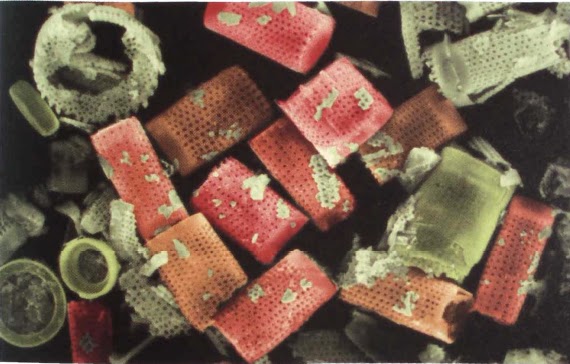

protozoa (incl. amoeba aka jelly babies),

Nematodes (not all nematodes are bad!)

The overall conclusion is that each part of the soil food web plays an important role in supporting plant life and you mess with it at your peril. Whilst many of us regard fungi as a nuisance as they attack our crops in the form of leaf curl disease on peaches, botrytis on our grapes or other fungal diseases, applying fungicide, even one considered safe by organic farmers such as Bordeaux mixture (copper sulphate and lime, the blue stuff everybody seems to spray on their vines and tomatoes) destroys all fungal life, poisons the soil and breaks an important link in the soil food web. Also adding liqud nitrogen feed has a long term negative effect. Whilst initially plants will grow better, it also destroys or at least severely damages the soil food web. In both cases you create a dependency having to constantly re-apply those substances and in the process making the soil poorer.
The authors also argue that tilling and double digging has a severely negative effect on the soil life, especially on the fungal rhizomes, which act like the communication web of a healthy soil. Theses mile long rhizomes get disconnected and distroyed, leading eventually to compaction and therefore again, leading to extra work again as the soil needs to be dug over again year after year. The life that lives in the soil is perfectly capable of doing the job for us if we only let it.
The second part of the book then deals with practical solutions by setting up 19 rules to using the soil food web, using just 3 tools. I don't agree fully with their conclusions. The 3 tools to create and work with the soil food web according to the authors are: composting, mulching and applying compost teas. As for composting, they give you the usual compost recipes. Whilst I agree that, if you make a compost pile you need to mix 'green', nitrogen rich materials (such as freshly cut grass and kitchen wastes) with 'brown' waste (such as old leaves and woody wastes), I am off building compost heaps as a major tool. The reasons for me are thus:
- Producing a compost heap at one corner of your yard, then involves transporting the final compost to where you need it, which partyicularly in my case with our steep land, involves considerable effort. Not to mention the effort of regularly turning your compost.
- While turning the compost and transporting it around, you disturb the soil food web you have created, thus going against the principles the authors advocate.
- If I produce a compost I use whatever happens to be at hand rather than following some sort of recipe, which depends on specific materials being available and possibly necessitating importing materials to get the 'correct' balance.
Mulching on the other hand is nature's way of adding organic matter to the soil. As you add mulch, it encourages beneficial fungi and bacteria. Worms will drag down some of the material into the soil and mix it in. Apart from that it of course suppresses weeds and minimises evaporation, meaning you need to water less.
For the compost teas, this is something I should try in the future. The authors advocate a method of Actively aerated compost teas (AACT). This involves some equipment to blow bubbles through some water with some compost added to it, which means extraction of the good bacteria and fungi is very quick and non-smelly. These teas are not only applied to the soil, but also sprayed onto foliage, strengthening the whole system and making it more resilient against harmful diseases and pests. Once I get around making one of those I shall write about it in a bit more detail.
Interesting also were the points made about the different preferences of different plants as to the symbiosises.. symbiosae symb... which parts of the soil food web they like to associate with. There are two basic types: bacterially dominated and fungally dominated. The bacteria are always the first to join any feeding frenzy, followed by fungi, who take a little longer to establish themselves. Most annual plants prefer a bacterially dominated soil, whilst perennials prefer a fungally dominated soil. That makes perfect sense again if you just observe nature. Pioneer species, such as the legumes, form relationships with nitrogen fixing bacteria, whilst of you look at a mature forest with long-lived trees... where is it that you find mushrooms?
So this is useful information for my bed building again. If you remember in my last post I was building a raised bed, where I am planning to plant perennials. We build it up using mainly brown materials, including whole branches and old leaves. These encourage a fungally dominated soil. I even threw in an old tree mushroom, to speed up the process. For your annuals on the other hand you should add plenty of green manure for them to flourish. My tomato beds also include some chicken manure which is rich in nitrogen.
On a final note on the book, they dedicate a whole chapeter on lawn maintenance. That seemed to me a bit of a waste of time. I don't think a lawn has any place in an ecologically balanced garden, as you constantly try and stop it doing what it wants to do, i.e. evolve into a forest. But all in all this is a really useful, well written and easily understandable book, which I can heartily recommend. Anybody out there short on money like myself, I do have the e-version on my hard drive and be happy to share it with anybody who wants it.
Finally, the pond really is taking shape now. Yesterday, already with an injured foot, we constructed the raised bed below the pond, which will be home to some soft fruit bushes:

It's about 5m long and will be filled up with predominantly brown materials. The pond itself is almost ready. It just needs another fott depth and some terracing within to give different levels of depth:


